Item Details
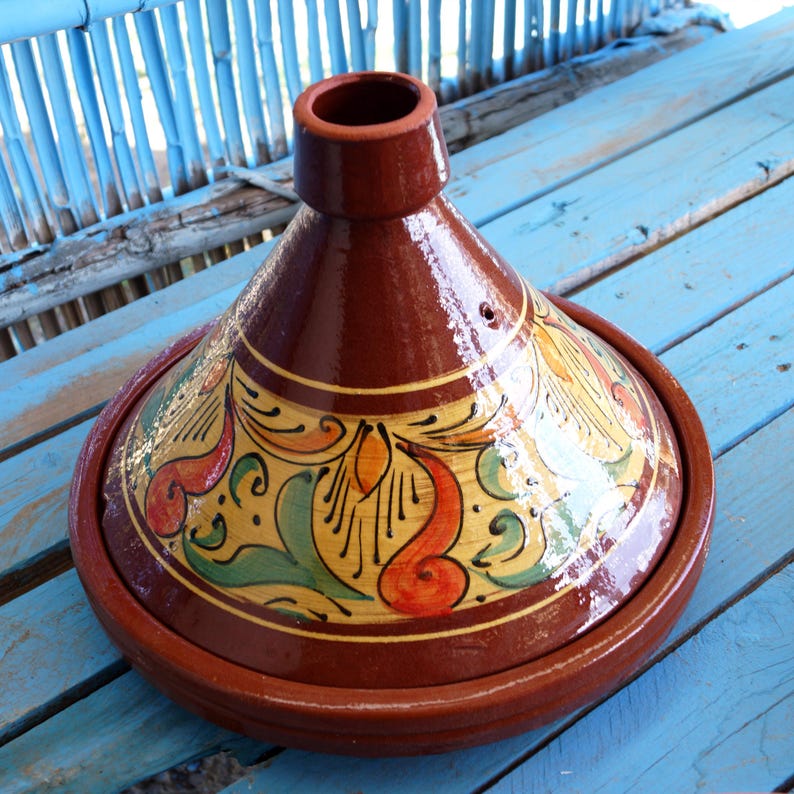
Hand-Painted Cooking Tajine — Safi
Hand-thrown terracotta, glazed and painted by hand in Safi. Built for slow-cooked stews on gas, charcoal, or in the oven.
Safi is the ceramics capital of Morocco. For four centuries, the clay pulled from the hills around the city has been thrown on foot-powered wheels in workshops that open straight onto the Atlantic wind. This tajine begins there — a single piece of local terracotta, shaped wet on the wheel, dried in open air for several days, then fired once in a wood kiln before the glaze goes on.
The painting happens by hand, brush by brush, with no stencils. Geometric borders, central rosettes, the deep cobalt blue and ochre and green that Safi has been known for since the eighteenth century — every motif is drawn from memory. After painting, the tajine is fired a second time. The glaze fuses to the clay, sealing the surface against liquids and locking the color in for the life of the piece. The base sits wide and heavy in the hand. The conical lid traps steam and circulates it back down through the food. That geometry is not decoration — it is the entire reason the dish works.
What Makes It
Hand-thrown Safi terracotta — the clay is local, the wheel is foot-powered, and every base carries the faint spiral ridges of the potter's fingers. No two are dimensionally identical.
Twice-fired glazed finish — first firing sets the clay body, second firing fuses the glaze. The result is a sealed cooking surface that handles direct heat without cracking when used correctly.
Hand-painted from memory — the geometric borders and central motif are drawn freehand. Look closely and the line weight shifts slightly between strokes. That variation is how you know a human held the brush.
Conical lid, engineered by tradition — the cone shape forces rising steam to condense at the peak and run back down into the dish, which is why a tajine slow-cooks meat and vegetables with almost no added liquid.
Works on multiple heat sources — gas, oven, or charcoal. For electric or induction, use a heat diffuser between the burner and the base.
The Craft
Throwing a tajine well takes years to learn. The base has to pull thin enough to conduct heat but thick enough to hold it. The lid has to seat perfectly on the rim without a gasket — the seal is geometry, nothing else. The painters train for longer still: the motifs of Safi are a closed visual language passed between hands, not written down. A finished tajine represents two distinct crafts, both practiced for a lifetime, coordinating around a single object.
Details
Material
Local Safi terracotta, twice-fired, food-safe glaze
Decoration
Hand-painted freehand motifs, no stencils
Construction
Foot-powered wheel-thrown base, hand-fitted conical lid
Origin
Safi, Morocco
Heat sources
Gas, oven, charcoal. Induction or electric: use a heat diffuser.
Lead time
5–7 working days per piece
Care
Before first use, submerge the tajine in cold water for 2 hours, dry, then rub the interior with olive oil and heat slowly. Hand-wash only. Never move directly from heat to a cold surface — terracotta cracks under thermal shock.
What's Included
The tajine (base and lid), packed in protective foam for international transit. A physical Origin Passport card with QR code linking to the verified workshop page: GPS coordinates of the Safi atelier, photographs of the throwing and painting process, the name of the kiln-master who fired this specific piece. DHL Express shipping, signed for at your door.
 Shipped via DHL Express · Fully tracked · Door to door from Morocco