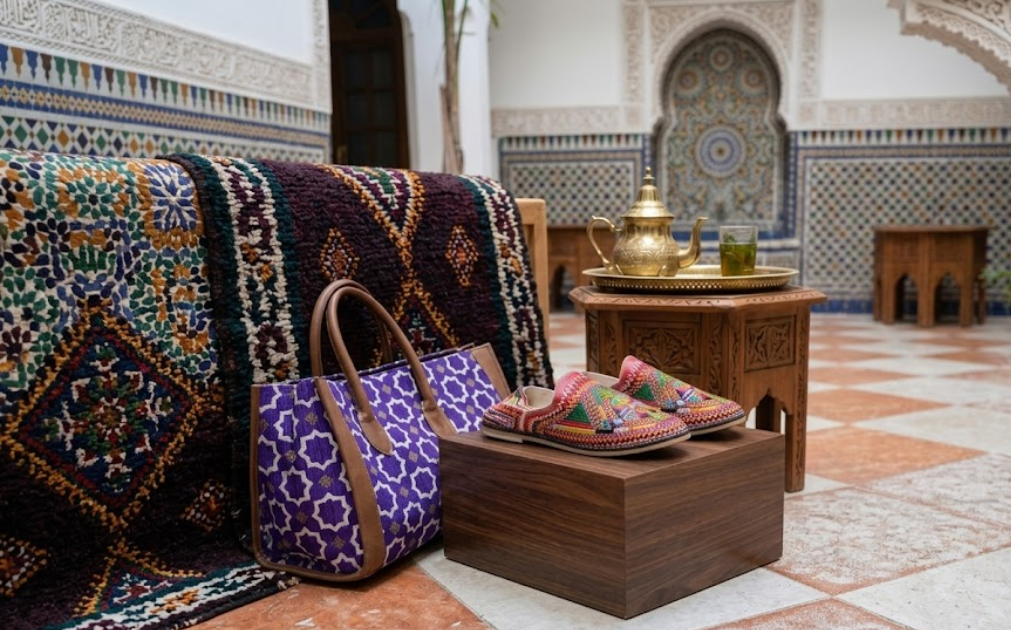
What Is Morocco Famous for Making? The Crafts That Built a Legacy
Morocco is famous for making zellige tile, hand-painted ceramics, brass lamps, natural leather goods, handwoven Berber rugs, and cactus silk textiles. These are living craft traditions practiced by 2.3 million artisans — not tourist products.
By Ziad El Khattabi
Morocco is famous for making things by hand that the rest of the world cannot replicate. Zellige mosaic tile. Hand-pierced brass lamps. Naturally-tanned leather. Hand-painted ceramics. Handwoven Berber rugs. Cactus silk.
These are not tourist products. They are the output of a living craft economy that employs approximately 2.3 million people — around 7% of Morocco's entire workforce — and has grown its international exports by 55% between 2019 and 2025. The United States is now the single largest buyer, accounting for nearly half of all Moroccan craft exports.
The problem is that most of what reaches international buyers under the label "Moroccan handmade" was not made in Morocco at all.
The Gap Between What Morocco Makes and What Buyers Receive
The story of what Morocco is famous for making starts in the workshops — but it rarely ends there. Intermediaries capture 80–90% of what international buyers pay. The master artisan who spent four to six days making a hand-pierced brass lamp in Fès receives 5–12% of the price it commands in a Paris boutique. He may not know what city it ended up in, or what it sold for.
The Moroccan government officially classified 32 craft specialities as threatened with extinction in 2025. Only four master artisans remain active in each. The economic pressure from cheap factory imitations — most produced in China and Vietnam and labelled as Moroccan — is a direct cause.
Technology changes this. At Kilimy, artisans can now submit voice notes in Darija via WhatsApp and receive a complete bilingual product listing in minutes — removing the language and digital barrier that has kept Moroccan craftspeople off international platforms. Every product ships with a certified Origin Passport. Every sale pays the maker directly.
Zellige — Morocco's Architectural Signature
If Morocco is famous for one thing above all others in the design world, it is zellige — the hand-cut geometric mosaic tile that covers the interiors of its mosques, palaces, and homes.
Zellige production has been centred in Fès since at least the fourteenth century. A craftsperson called a mâalem fires a flat ceramic tile, then cuts it piece by piece using a small chisel and hammer. Geometric precision at this scale takes a decade of apprenticeship to master.
Interior designers across the US and Europe named Moroccan glazed tile as one of the defining materials of 2026. The reason is that nothing machine-made produces the same visual depth or the same play of light across a wall.
Ceramics — A Thousand Years of Practice
The pottery workshops of Fès have been producing hand-painted blue and white ceramics since the medieval period. The craft is concentrated in specific family workshops, where techniques for clay preparation, wheel-throwing, pattern application, and glazing have been refined across generations.
Safi — a coastal city synonymous with pottery — produces a distinct style in earthier, warmer tones. The two cities together are responsible for the majority of Morocco's ceramic production. Both produce objects that are wheel-thrown, hand-painted, and fired in wood or gas kilns — with the visible weight, variation, and evidence of the human hand that no factory equivalent can fake convincingly if you know what to look for.
Brass Metalwork — The Sound of the Seffarine
Walk through the Seffarine district of Fès medina and you hear it before you see it: the rhythmic ring of hammers on brass and copper, dozens of artisans working simultaneously in workshops that have occupied the same buildings for centuries.
A Moroccan brass lamp is one of the most recognised objects in contemporary interior design. Interior designers named warm aged brass as a defining material of 2026, citing the way genuine hand-pierced metalwork transforms a room with light and shadow. A single lamp can take a master artisan four to six days to complete. The pattern is memorised rather than drawn — passed from maâlem to apprentice across generations.
Leather — The World's Most Photographed Tanneries
The Chouara tannery in Fès has operated continuously since the eleventh century using the same vat-based natural dyeing process: saffron for yellow, indigo for blue, poppy for red, mint for green. The resulting leather — from goat, sheep, and camel hides — is supple, naturally aromatic, and improves with age.
Moroccan leather becomes babouche slippers, bags, belts, wallets, and the round leather poufs that are Morocco's most globally distributed craft product. The leather pouf sitting in a home in New York or London has a supply chain that, without direct platforms like Kilimy, passes through three or four intermediaries — each capturing a share of value the artisan who made it will never see.
Berber Rugs — Woven Stories
The Beni Ourain rug — cream pile with black geometric patterns, woven by Berber women of the Middle Atlas — has appeared consistently in international interior design coverage for fifteen years. But it is only one of dozens of distinct Moroccan rug traditions. Azilal rugs from the High Atlas are colourful and abstract. Kilims from the south are flatwoven and graphic. Boucherouite rugs are made from recycled fabric and entirely unique by definition.
Each genuine handwoven Moroccan rug is weeks or months of one person's sustained effort. The craft is predominantly practiced by women in Berber communities, for whom it has been both a livelihood and a form of cultural expression for centuries.
Cactus Silk — The Fibre the World Is Just Discovering
Cactus silk — sabra — is extracted from the leaves of the agave plant and woven into a luminous, iridescent textile by women's cooperatives in southern Morocco, particularly in the Souss Valley. It remains far less internationally well-known than Moroccan ceramics or rugs — which means it is currently undervalued and still produced at genuine craft scale.
What Morocco Makes Is Worth Buying at Its Actual Value
What Morocco is famous for making deserves to reach the buyer in a way that honours the person who made it. Kilimy connects those artisans directly to international buyers — with verified proof of origin for every piece, and direct fair payment to the craftsperson. The craft traditions that Morocco has built over centuries will survive if — and only if — the people practicing them can earn a living from doing so.
Continue Reading

Ships from Marrakesh
Verified Artisan · Marrakesh
Handmade Moroccan Clay Tagine – Traditional Fez Cooking Pot

Ships from Marrakesh
Verified Artisan · Marrakesh
Safi-Style Brown Ceramic Tagine with Hand-Painted Detail

Ships from Marrakesh
Verified Artisan · Marrakesh
Marrakesh Terracotta Tagine – Unglazed Clay Cooking Pot
Only 1 left