KILIMY
← Journal
CeramicsMarch 26, 2026· 5 min read

What Is Morocco Famous For? Beyond the Medinas — The Craft Traditions That Define the Country

Morocco is famous for its medinas, cuisine, and landscapes — but its deepest legacy is its craft traditions. Zellige tile, hand-painted ceramics, brass lamps, leather goods, and Berber rugs are the products that have shaped Morocco's identity and economy for centuries.

By Ziad El Khattabi

Morocco is famous internationally for its medinas, its cuisine, the Sahara, and the blue city of Chefchaouen. But ask what the country actually produces — what it makes with its hands — and the answer is something older and more specific than any of those things.

Morocco is famous for making things. Things that take time. Things that require skill passed from one generation to the next. Things that cannot be replicated by a factory.

The Craft Economy Behind the Country

Morocco's artisan economy supports approximately 2.3 million people — around 7% of the national workforce — and has grown its international exports by 55% between 2019 and 2025. The United States is now the single largest buyer, accounting for nearly half of all Moroccan craft export revenue. Moroccan craft exports reached MAD 1.23 billion in 2025.

This is not a legacy industry in decline. It is a growing export business built on centuries of accumulated expertise.

The challenge is a structural one: intermediaries currently capture 80–90% of what international buyers pay. The artisan receives 5–12% of the retail price their work commands in Paris, New York, or London. The Moroccan government classified 32 craft specialities as officially endangered in 2025, with fewer than four master artisans remaining active in each. The most effective solution — the one that changes the economics — is direct connection between maker and buyer, with verified proof of origin and transparent payment.

The Crafts That Define Morocco

Zellige — The Tile That Built a Visual Identity

The hand-cut geometric mosaic tile called zellige is Morocco's most architecturally significant contribution to the world. A craftsperson called a mâalem cuts each piece individually using a small hammer and chisel. The geometric precision required across hundreds of individually cut pieces takes a decade of apprenticeship to master.

Interior designers across the US and Europe named Moroccan glazed tile as one of the defining materials of 2026. Nothing machine-made produces the same visual depth or the same play of light across a wall.

Ceramics — The Potters of Fès and Safi

The pottery workshops of Fès have been producing hand-painted blue and white ceramics since the medieval period. Safi — a city synonymous with pottery — produces a distinct style in earthier, warmer tones. Both cities produce objects that are wheel-thrown, hand-painted, and fired in kilns — with the weight, variation, and evidence of the human hand that factory production cannot replicate.

Brass and Copper — The Sound of the Seffarine

The Seffarine district of Fès medina has been the city's metalworking centre for centuries. A master artisan in the Seffarine spends four to six days making a single pierced brass pendant lamp — working hole by hole with memorised patterns, a tradition passed from maâlem to apprentice across generations.

Warm aged brass was named a defining material of 2026 by interior designers — specifically for the way Moroccan hand-pierced metalwork transforms a room with patterned light. No industrial equivalent produces the same effect.

Leather — The Tanneries That Have Run for a Thousand Years

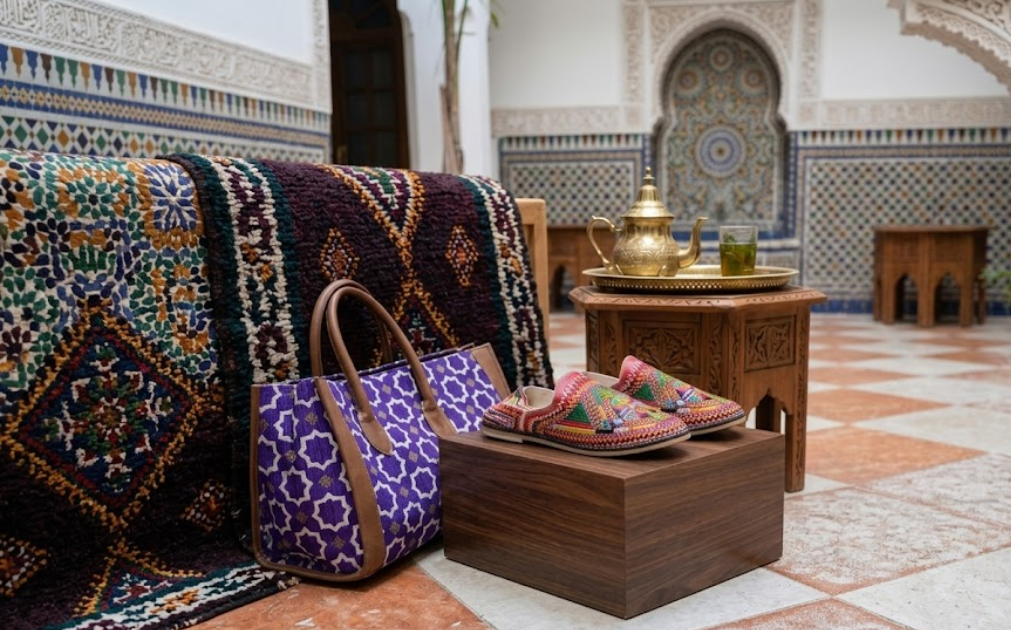
The Chouara tannery in Fès has operated continuously since the eleventh century, using natural dyes — saffron, indigo, poppy, mint — in large stone vats. The leather produced here becomes babouche slippers, bags, belts, and the round leather poufs that are among Morocco's most globally distributed craft products.

Kilimy was founded in part because of a moment in a Fès workshop: watching a master artisan sell a piece he had spent five days making for €16 to an intermediary, who would eventually sell it for thirty times that in a European boutique, with none of the difference reaching the maker. Direct platforms change that equation entirely.

Berber Rugs — Woven in the Atlas

The Berber (Amazigh) communities of the Atlas Mountains and the Saharan south have been weaving rugs for centuries. The Beni Ourain rug — thick cream pile with black geometric patterns — is one of the most internationally recognised pieces of Moroccan craft. But it is only one of dozens of distinct regional styles, each with its own visual language. Moroccan rug weaving is predominantly women's work — a domain of creativity, cultural preservation, and economic independence.

Cactus Silk — The Craft the World Is Still Discovering

Produced from agave fibre in the Souss Valley and surrounding areas of southern Morocco, cactus silk — sabra — creates a luminous, iridescent textile unlike any other natural fibre. It is the least internationally well-known of Morocco's major crafts, which means it is currently both undervalued and produced at genuine scale.

Why Morocco's Crafts Are More Relevant Now Than Ever

The global interior design conversation of 2026 is about exactly the qualities Moroccan craft embodies: natural materials, authentic craftsmanship, provenance, sustainability, and the human story behind an object.

The sector is also at an inflection point. Thirty-two specialities are endangered. Youth unemployment in Morocco runs above 37%, and young people see the trades as economically unviable when the value they generate flows primarily to intermediaries. The technology that fixes this — direct verified commerce between maker and buyer — is what Kilimy is building, starting with Morocco and building toward the same model across West Africa: Senegal, Côte d'Ivoire, Kenya, where the same artisans, the same skills, and the same structural problems exist without any solution yet.

What Morocco is famous for making is a living tradition. Kilimy connects those makers directly to the buyers who want what they produce — with a certified Origin Passport for every piece, and direct payment that reaches the craftsperson who earned it.

Continue Reading

March 25, 2026

How to Tell If Moroccan Ceramics Are Really Handmade (And Why Most Aren't)

Read →

March 24, 2026

What Is Morocco Famous for Making? The Crafts That Built a Legacy

Read →
Shop from this collection →
Handmade Moroccan Clay Tagine – Traditional Fez Cooking Pot

Ships from Marrakesh

Verified Artisan · Marrakesh

Handmade Moroccan Clay Tagine – Traditional Fez Cooking Pot

$239.00$244.00-2%
★★★★★4.8 (77)
Safi-Style Brown Ceramic Tagine with Hand-Painted Detail

Ships from Marrakesh

Verified Artisan · Marrakesh

Safi-Style Brown Ceramic Tagine with Hand-Painted Detail

$154.00$161.44-5%
★★★★★4.9 (84)
Marrakesh Terracotta Tagine – Unglazed Clay Cooking Pot
New

Ships from Marrakesh

Verified Artisan · Marrakesh

Marrakesh Terracotta Tagine – Unglazed Clay Cooking Pot

$74.00$85.78-14%

Only 1 left

★★★★★4.7 (101)