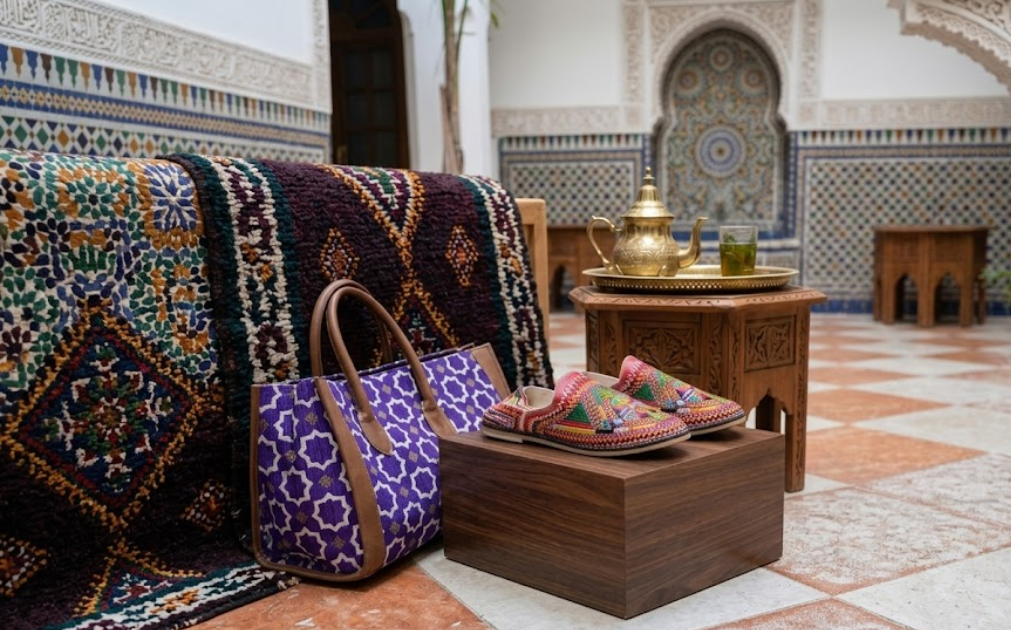
What Crafts Is Morocco Famous For? The Complete Guide to Moroccan Artisanship
Morocco is famous for zellige tilework, hand-painted ceramics, brass lamps, leather goods, handwoven rugs, and cactus silk textiles. Each craft has a specific city of origin, a technique refined over centuries, and an artisan tradition still active today.
By Ziad El Khattabi
Morocco is famous for six major craft traditions: zellige tilework, hand-painted ceramics, brass and copper metalwork, naturally tanned leather goods, handwoven Berber rugs, and cactus silk textiles. Each originates in a specific region, uses materials unique to that place, and is still produced today by working artisans.
This is not a historical tradition preserved in museums. It is a living economy that supports approximately 2.3 million people — around 7% of Morocco's GDP. Between 2019 and 2025, Moroccan craft exports grew by 55%. The United States is now the single largest buyer, accounting for nearly half of all export sales.
Zellige — The Art of Hand-Cut Mosaic Tile
Zellige is Morocco's most architecturally significant craft — individually hand-cut geometric tiles assembled into intricate mosaic panels covering the walls, fountains, and floors of mosques, palaces, and homes across the country.
A craftsperson called a mâalem fires a flat ceramic tile, then cuts it piece by piece using a small hammer and chisel, shaping each fragment to fit the specific pattern. The geometric precision required — cuts meeting at exact angles across hundreds of individual pieces — takes years of apprenticeship to master.
Fès is the historic centre of zellige production, with a tradition dating to at least the fourteenth century. In 2026, interior designers explicitly named Moroccan glazed tile as one of the defining materials of the year. The reason is simple: nothing machine-made produces the same visual depth or the same play of light across a wall.
The Moroccan government classified zellige production among 32 craft specialities officially at risk of extinction in 2025 — with fewer than four master artisans still practicing each. The solution is not preservation programs. It is direct economic connection between the artisan and the international buyer willing to pay what the work is worth.
Ceramics — Hand-Painted Pottery from Fès and Safi
The pottery workshops of Fès have produced hand-painted blue and white ceramics since the medieval period. Patterns are applied freehand in cobalt blue by artisans called naqshbin. Safi — a coastal city whose name is synonymous with pottery — produces a distinct style in warmer palettes: greens, ochres, and terracotta.
Both traditions produce functional objects — tagines, serving plates, tea cups, bowls — alongside purely decorative pieces. What distinguishes authentic Moroccan ceramics from industrial imitations is the hand behind each piece: slight variations in line weight, natural irregularities in glaze pooling, and the weight that comes from wheel-throwing rather than slip-casting.
For anyone wanting to understand the full depth of this tradition, the Batha Palace Museum in Fès — a museum of arts and crafts housed inside a nineteenth-century palace — holds the historic collection of Fassi blue ceramics, carpets, and decorative objects that document what the craft looked like before any commercial pressure changed it. It is worth visiting before you buy anything.
Brass and Copper Metalwork — The Lights of Fès
Morocco's brass and copper metalwork is concentrated in the Seffarine district of Fès medina — a square that has been the city's metalworking centre for centuries. Walk through it and you hear the craft before you see it: rhythmic hammering, dozens of artisans working simultaneously.
In Marrakech, the Attarine souk is dedicated specifically to brass and copper: the Moroccan National Tourist Office describes it as a place where "from bronze to gilded copper, the sumptuous objects come in every possible shade." Both cities are producing objects for international interiors — but the craft is evolving. Moroccan metalworkers are increasingly redesigning ancestral forms for contemporary use, with modern versions of traditional pieces appearing in the most design-forward interiors globally.
A master artisan in the Seffarine spends four to six days making a single pierced brass pendant lamp — working hole by hole with a series of chisels, the pattern memorised rather than drawn. When lit, the lamp projects an intricate lattice of light and shadow across every surface in the room. No industrial lighting product replicates this effect, which is why warm aged brass was named a defining material of 2026 by interior designers across the US and Europe.
Leather — The Tanneries That Have Run Since the Eleventh Century
The Chouara tannery in Fès has operated continuously since the eleventh century using largely unchanged methods: lime soaking to remove hair, vegetable tanning to cure the leather, plant-based dyeing with saffron, indigo, poppy, and mint.
The finished leather becomes babouche slippers, bags, belts, and the leather poufs that are among Morocco's most exported craft products. Intermediaries capture most of what international buyers pay — artisans currently receive 5–12% of the retail price their work commands in Paris or New York. Kilimy's direct payment model is designed to change that ratio fundamentally.
Handwoven Rugs — Berber Weavers of the Atlas
Moroccan rug weaving is rooted in the Berber (Amazigh) communities of the Atlas Mountains, where it has been a primary craft for women for centuries. Several distinct styles exist:
Beni Ourain — thick cream pile with black geometric patterns from the Middle Atlas. A staple of contemporary international interior design for over a decade.
Azilal — colourful and personal, from the High Atlas. Each rug reflects the individual weaver's creative decisions, made from memory rather than a pattern.
Boucherouite — recycled fabric scraps woven into bright, abstract designs. Entirely unique by definition.
Kilim — flat-woven, graphic, lightweight. Versatile for floors, walls, and throws.
A genuine handwoven Moroccan rug takes weeks to months. The back shows the same pattern as the front, each knot individually visible. Machine-made imitations sold as "Moroccan" on major platforms have no relation to this tradition.
Cactus Silk — The Craft the World Is Discovering
Cactus silk — sabra — is extracted from the agave plant and woven by women's cooperatives in southern Morocco, particularly in the Souss Valley. The resulting textile has a natural iridescent sheen, is hypoallergenic, and becomes softer with washing.
It is the least internationally well-known of Morocco's major crafts — which means it remains underpriced relative to its quality, and the cooperatives that produce it are still working at authentic scale rather than industrial volume.
Why These Crafts Are Under Threat — and What Changes It
Thirty-two of Morocco's craft specialities were officially classified as endangered in 2025, with only four master artisans still active in each. The cause is economic: when intermediaries capture 80–90% of what buyers pay, there is no sustainable income for the craftsperson. Young Moroccans with a 37% youth unemployment rate see the trades as unviable careers.
The only structural fix is technology that eliminates the intermediary layer entirely — connecting the artisan directly to the international buyer, with verified proof of what they are purchasing and direct, transparent payment to the maker.
That is what Kilimy does. Every product ships with an Origin Passport certifying who made it and where. Every sale pays the artisan directly. Shop ceramics, copper and brass, textiles, and lighting — all verified, all with a certified Origin Passport. The crafts Morocco is famous for will survive if — and only if — the people who make them can earn a living from making them.
Continue Reading

Ships from Marrakesh
Verified Artisan · Marrakesh
Handmade Moroccan Clay Tagine – Traditional Fez Cooking Pot

Ships from Marrakesh
Verified Artisan · Marrakesh
Safi-Style Brown Ceramic Tagine with Hand-Painted Detail

Ships from Marrakesh
Verified Artisan · Marrakesh
Marrakesh Terracotta Tagine – Unglazed Clay Cooking Pot
Only 1 left